
Posted 13th March 2008 | 3 Comments
Network Rail announce Easter work programme
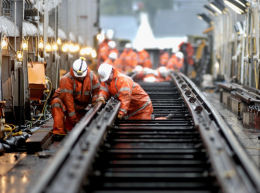
Military-style command centres will be used by Network Rail when the company embarks on track and signalling improvements totalling £75 million over the Easter break.
Network Rail has been consulting within the rail industry on the best way to deliver significantly more trains on the West Coast without unplanned disruption for passengers.
The company is planning to deliver a £750m programme of investment in just nine months.
Now Network Rail is approaching a major test of the way it has planned for the Easter work, which will be nationwide.
Iain Coucher, Network Rail chief executive said: "In just four days over Easter Network Rail will deliver 300,000 hours of improvement work across the country. Around 6,000 engineers will be working day and night to meet demands for a better railway from the travelling public.
"Following the New Year, we have listened to passengers and those who represent them and now our planning and preparation is more robust than ever. Each project is an immense engineering challenge in its own right, and Network Rail is absolutely determined to deliver a safe and reliable railway back to passengers and freight users at the promised time.
|
HAVE YOUR SAY
“The railway needs more capacity but Network Rail needs to move away from over reliance on extended route blockades” Dominic, Manchester What do you think of Network Rail's Easter improvement programme? Have your say |
During the four day holiday the company says it will be installing 25 miles of track, new signalling and points and replacing a viaduct on the Cumbrian Coast line.
Engineers will also be returning to Rugby as part of the £415 million remodelling of the station for West Coast modernisation.
Such is the need to complete the work and hand the track back to the train operators on time, Network Rail's director of infrastructure investment, Simon Kirby, will be heading up the project during the four day break.
The decision to move towards command centres with clear lines of authority follows the disruption caused to train-running over the Christmas and New Year break when major engineering work at Rugby, Liverpool Street and in Glasgow overran.
The debacle led to Network Rail being fined £14m by the Office of Rail Regulation and being called on to come up with a 'robust' plan for the completion of the West Coast modernisation work by December this year.
The command centres are based on the system of 'Gold Commands' which are set up by emergency services during major incidents and will ensure clear lines of command between Network Rail, train operators and contractors.
"Because of the volume of work this Easter, we're advising people to double check their travel plans. We'll be working closely with the train operating companies and National Rail Enquiries to make sure that the very latest information is available."
Network Rail is working closely with train operators, Passenger Focus and other partners in the rail industry to get up-to-date information to passengers before they travel. Travel information for Easter has been available from National Rail Enquiries for several weeks.
West Midlands
Upgrading the track, signalling and overhead head power lines in the Trent Valley area on the West Coast main line where more tracks have been added to reduce journey times of London to Manchester trains and to increase the frequency of services.
At Rugby engineers will be installing new track and signalling, replacing the current passenger subway under the station.
In Nuneaton £2.4m is being spent on new points and signalling. This will help to increase train speeds through a key junction on the West Coast Main Line to 125mph.
For more details about the West Coast Modernisation click here: http://www.networkrail.co.uk/aspx/4615.aspx
East Anglia and South East
Upgrading track, power lines and carrying out platform works at Milton Keynes station.
Work on a £25m project in Barnham, Sussex, linked to the introduction of a modern signalling system that will increase train reliability.
As part of a £5m scheme in Kent the Rochester River Bridge is being strengthened to reduce the long term effects of the weather and maintain the life of the structure.
A £6m project to modernise the track around Shenfield, Essex. The new design is less noisy and will reduce the need for maintenance closures.
London
A £3m project over four days to renew large sections of the track at Clapham Junction.
Overhead line replacements are also taking place at Liverpool Street and Bethnal Green to improve the reliability of the railway
North East, Yorkshire and Humberside
A total of £750,000 is being spent to improve the reliability of trains on routes from Leeds to Huddersfield, York to Doncaster and Newcastle to Carlisle.
North West
In partnership with Cheshire County Council, the Wistaston Road railway bridge in Crewe is being upgraded to bring it in line with EU regulations and to maintain vehicle access. Without this improvement, a permanent weight limit would be required.
Network Rail is replacing the deck on the 50m Calder Viaduct that carries a railway over the River Calder/River Ehen on the Cumbrian coast. This will enable the existing speed restriction for freight trains to be lifted.
South West
Delivering the final phase of an £8.8million project in Swindon East to improve the condition of the railway and to increase line speeds.
East Midlands
Work continues on a £18m station project to rebuild the canopies at Derby station
Wales
Engineers will be working to remodel the track at Abercynon. This project is part of a wider enhancement scheme to increase the frequency of services on the Cardiff Valleys lines.
Scotland
Track renewals will be carried out between Lochwinnoch and Glengarnock, in Inverclyde.
Reader Comments:
Views expressed in submitted comments are that of the author, and not necessarily shared by Railnews.
Terry Piper, Altrincham, England
It's frustration for travellers to face longer and complicated journeys during periods of engieering work. Most of us hate the bus replacements that are often the only alternative and it puts people off travelling at all - the days of the train taking the strain seem to be a thing of the past.
Christopher Metcalfe, Barnoldswick, Lancs
Way back, I think in the Thatcher years there was a drive to reduce track mileage (capacity) to make the railways efficient. We are now reaping the problems. Network Rail have a difficult task. Any large project will undoubtedly create unforseen problems as I expereinced travelling the Airdale line into Leeds daily in the 90's. The benefits are now enjoyed by customers. there is a vital need for alternative track and routes. i.e where there was 4 track, that need to be reinstated. Where singled, that need to be doubled etc.
Dominic, Manchester, Greater Manchester
The railway needs more capacity but Network Rail needs to move away from over reliance on extended route blockades. Also there needs to be greater planning such as use of the Midland Mainline as an alternative route to the WCML as occurred during earlier phases of the route modernisation. Bus replacement services are just not adequate. The rail industry can only lose customers if regular bus replacement services are adopted as a matter of course. Notwithstanding all of this the improvements at Rugby and TV4 have the potential to make the WCML a much more efficient railway and can only be welcomed.