
Posted 1st September 2026
Comment: a brave experiment?
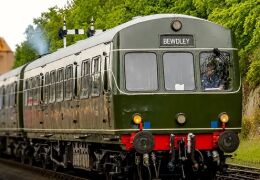
(picture: SVR)
3 comments
At 06.40 this morning a rather special train left Bewdley in Worcestershire, destination Kidderminster.
This was special because it was carrying 'normal' National Rail passengers, who can change at Kidderminster and travel on to Birmingham on West Midlands Railway.
It was one of two morning departures, with two return workings in the evening, and they form part of an eight-week experiment to see if there is demand for such a service.
Certainly the fare is not excessive. National Rail says it is £2 single as far as Kidderminster, which is far cheaper than the usual heritage fares.
But a possible flaw is that the experimental services will run only on Tuesdays, Wednesdays and Thursdays, which would leave commuters working a five day week left to find their own way on other days.
The dream of attracting 'normal' passengers to heritage railways has been around for a long time. The Bluebell Railway, the West Somerset and the South Devon line to Kingswear were just some of the hopefuls. Of these three, only the Paignton-Kingswear route actually carried trains for schoolchildren in the early days, but the trial soon ended.
There are several hurdles. One is the limited speed of heritage railways with a Light Railway Order (40km/h or 25 mph), which means that journeys on longer lines will be very slow. And no, the National Rail trains cannot go faster. The limit is absolute.
Another is maintaining a regular NR service. Heritage railways usually close off-season for major maintenance, and that would mean no trains.
A third is the possible lack of interest by volunteers, particularly if the trains are National Rail units. They give their time to recreate a railway of bygone days, not one worked by Class 150 units.
Indeed the Severn Valley Railway has demonstrated one of the limitations, because this special service will only run three days a week. Some people might use it for its novelty value, but longer-term custom is less certain.
We wish the SVR well, but it seems to us that trying to combine heritage and NR services is always a tough nut to crack, although it is true that the North Yorkshire Moors runs through to Whitby on Network Rail infrastructure.
We will be watching this trial with great interest.
Readers’ comments
As this is a trial, I found some of the comments in the piece are negative. The SVR part of the journey will be using their own Heritage sets which is positive for the volunteers and Im sure those travelling the 12 mins to Kidderminster are not too bothered about the 25mph when takes considerably longer via road transport. David Cresswell RITTech MBCS, Walsall
[Pros and cons, David. In this case, the speed limit is not a problem, I agree. (I did say ‘on longer lines’, which this trip is not.) But only three days out of seven might be a hurdle.–Ed.]
Light railways are subject to the 25 mph limit I assume because that was the fastest it could be safe at the time the light railway was built, to be without possibility of serious collision damage. With modern technology, to prevent crashes, could it be safe to increase the light railway limit to, say 40mph? David C Smith, Bletchley
[Many different factors are involved. Signal sight lines and level crossing approaches are just two, so LRO-equipped lines might need quite a lot of work. ‘Modern technology’ sounds like TPWS, and that won’t be cheap. Business case?–Ed.]
I can see there would be nothing gained in swapping a higher speed limit for additionalr other expenses in the form of modern technology. What I had in mind in particular was the superior adhesion and braking in modern rolling stock. David C. Smith, Bletchley
What do you think? Click here to let us know.