
Posted 19th August 2026
'Rough riding' reported at site of Lewes derailment

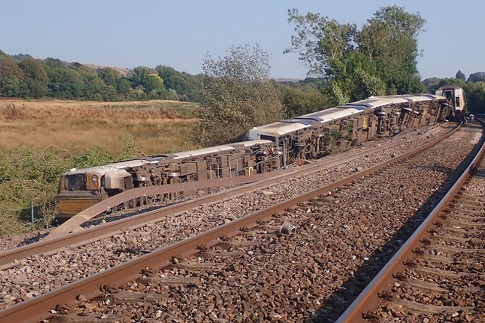
Rough riding had been reported at the site near Lewes where a train from London to Eastbourne became derailed on 13 August.
The last three vehicles left the rails and overturned in a field by the line. Thirty people were injured, and of these 20 required hospital treatment. Two of them were seriously hurt.
The Rail Accident Investigation Branch has published its first report into the accident, and it said preliminary analysis of ‘black box’ data obtained from the front vehicle shows that the train was travelling at around 65 mph (105 km/h) as it approached the point of derailment. Preliminary analysis also shows that the driver applied the brakes as the train passed the point of derailment, and that the train started to decelerate.
The RAIB said marks observed on the rails near the point of derailment are ‘consistent with the wheels of the derailed rear vehicles having climbed over the rails’.
CCTV images recorded by preceding services using these lines show that a ‘track geometry irregularity’ existed on the immediate approach to the point of derailment. There was also evidence of previous track maintenance in this area. Following the accident, RAIB has received several reports of rough riding at the location of the derailment from passengers on other trains. The RAIB said it continues to analyse evidence relating to the derailment and the status of the track.
The recovery of the train will be complex and will include the derailed vehicles being lifted by rail crane and moved by road to secure storage.
CCTV recordings, signalling data and radio communications data have also been obtained. The train, track, and embankment at the site of the accident have been examined and surveyed by various methods including laser scanning and aerial photography.
The weather on the day of the accident was hot and sunny, with little wind. Theair temperature at the time of the derailment was recorded as being around 27C by the nearest weather station to the accident. The accident took place during a sustained period of hot and dry weather.
The embankment at this location is constructed of clay and sits on alluvial/alluvium deposits (consisting of loose clay, silt, sand and gravel). Both are sensitive to variations in water content and may undergo movement as moisture levels change. Although, at this stage, there is no evidence to indicate that a significant embankment slip occurred before the accident, there is evidence that some movement had previously taken place.
The investigation is continuing.
What do you think? Click here to let us know.