
Posted 10th September 2009 | No Comments
Serco starts operating new £4.6 billion Dubai Metro after 50,000 training days
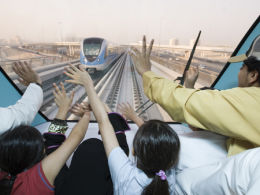
BRITAIN'S Serco Group is set to become the world's biggest operator of driverless metros following the official opening of the first part of Dubai's £4.5 billion Metro system.
Serco already has experience of operating two of the automated metros - Docklands Light Railway in London and Copenhagen Metro in Denmark.
Now it has started operating Dubai's Red Line following its official opening by Sheikh Mohammed bin Rashid Al Maktoum, ruler of Dubai, at 9.09pm on 9 September - 9.09.09.09.09.
Initially the Metro serves 10 key stations on the Red Line - including Terminal 3 at Dubai International Airport, the Financial Centre and the Mall of the Emirates. The remaining stations on the Red Line will be opened in phases over the next few months and are due to be completed by February 2010.
Nick Brown, Chief Executive of Serco Integrated Transport & Middle East, said: "Serco as one of the world's leading operators of driverless metros is proud to be working in partnership with the RTA [Roads & Transport Authority] to deliver a safe and secure system.
"It will be one of the most advanced urban rail systems in the world and the cornerstone of the RTA's vision for an integrated public transport system for Dubai."
Serco's team in Dubai has been working for two years as part of the build-up to the inauguration and says that during that time it has "delivered an in-depth programme of over 50,000 training days to equip some 3,000 employees with the safety and technical skills needed to deliver a world class and safe railway."_
Serco says its innovative approach to training is "creating a fast moving, dynamic culture where people from many regions with a wide experience have created a workforce with unique and exciting capabilities for Dubai."
Serco will run the Operations Control Centre, provide train attendants and all the staff at the stations as well as operating and maintaining the Metro infrastructure and rolling stock.
The Dubai Metro is the first of its kind in the Middle East region. It features fully automatic driverless trains - with on-board information and air conditioning - having a maximum speed of 90km/h (56 mph).
For many of Dubai's foreign guest workers, the metro could mean far quicker commutes in a sprawling city-state where shared taxis, packed vans and wooden boats are among the most visible forms of public transportation.
As well as having both First and Standard class accommodation, each five-car train has a separate compartment reserved for women and children. Women are able to sit in other cars as well.
The Chairman and Executive Director of the Dubai Roads & Transport Authority, Mattar Al Tayer, said: "The launch of the Dubai Metro brings to fruition the key element of His Highness Sheikh Mohammed bin Rashid Al Maktoum's vision for developing Dubai's transport infrastructure and has been completed in record breaking time."
The Red Line, which will have 29 stations in total, is 52 km (32 miles) long and will run from Rashidiya to Jebel Ali.
The Green Line, which will launch in June 2010, is 22 km (14 miles) long and will run from Eitisalat to Al Kour with 18 stations.
Initially, the Red Line with 10 stations will have a capacity of 3,500 passengers every hour. When fully operational the Metro is expected to carry over 1.2 million passengers on an average day.
** As the Dubai Metro was opened, Emirates Airline flew one of its five A380 Airbuses so far in operation from Dubai into Birmingham Airport for the opening of the airport's £40 million new air bridge for international flights. Commentators observed this was Birmingham Airport's second international terminal to be built since 1984 whereas the adjacent Birmingham International railway station has now stood unaltered since it opened in 1976.